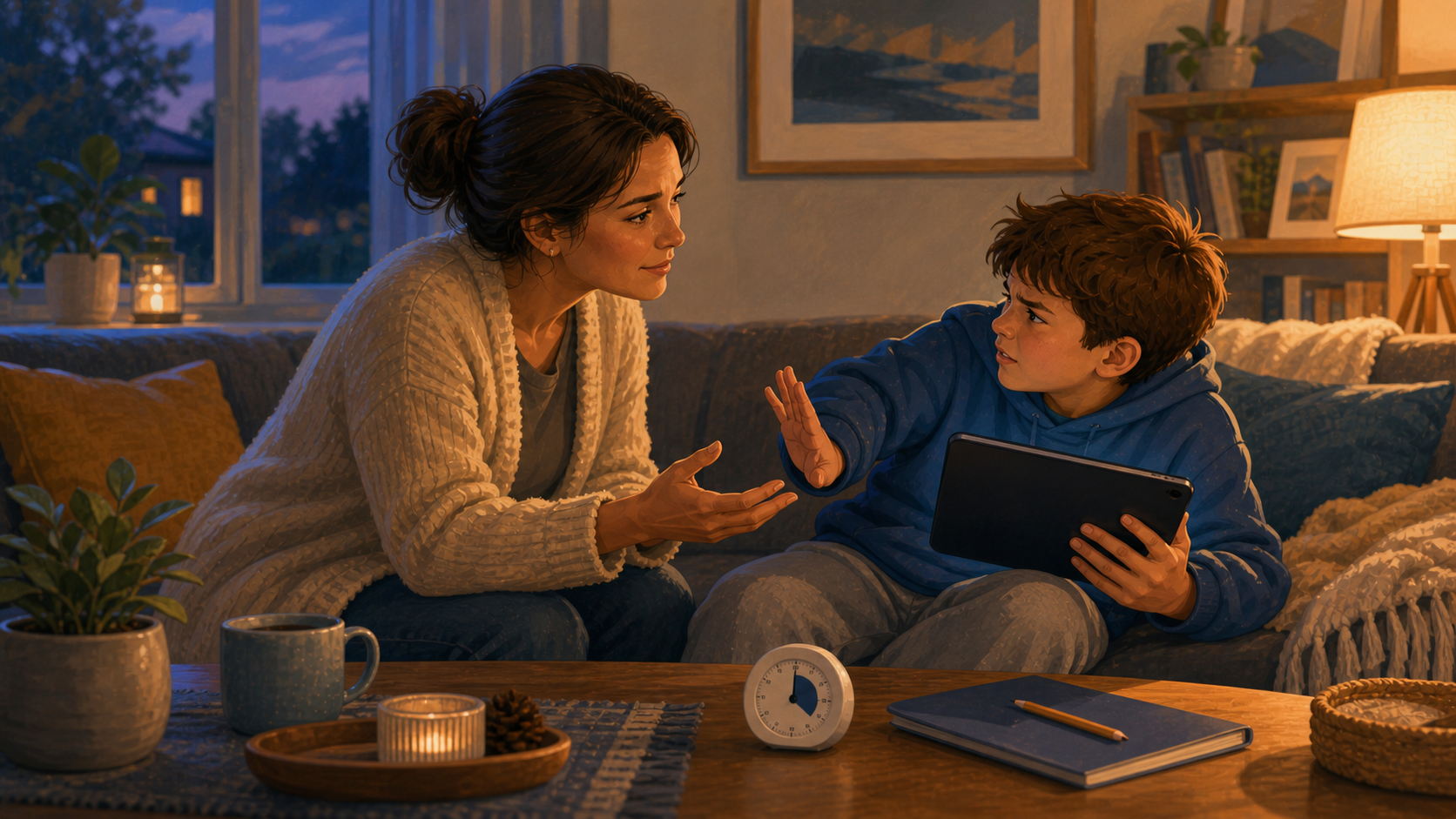
Many parents assume that if a child reacts strongly to a screen-time limit, the issue must be defiance. Sometimes it is simpler than that. You are interrupting a rewarding activity, often at the exact moment the child feels absorbed in it, and replacing it with a demand they did not choose.
That does not mean the limit is wrong. It means the pushback is often psychologically predictable. If you understand why it happens, you can set firmer boundaries with less drama.
Short answer: kids push back harder when a screen limit feels like sudden loss of control, when the activity is designed to hold attention, and when the family rule has to be renegotiated every time instead of being predictable.
It is not just "screens are fun"
The American Academy of Pediatrics has moved beyond talking about raw screen hours alone and now emphasizes the wider digital environment children are dealing with. In its 2026 guidance, the AAP notes that features like autoplay, endless scrolling, targeted ads, notifications, and reward loops are designed to keep children engaged longer.
That matters because parents are not only competing with a cartoon or a game. They are often asking a child to stop using a product that has been intentionally built to reduce stopping points. The AAP's family media planning advice now explicitly recommends turning off autoplay and notifications where possible for exactly this reason.
If you want the broader research context for why content and context matter more than a crude daily number, start with The science behind screen time limits. The design of the activity changes the feel of the limit.
Loss of control is part of the reaction
A useful lens here comes from self-determination theory, a major framework in motivation research. It argues that people cope better with demands when autonomy, competence, and connection are supported rather than ignored. That theory is not a screen-time study by itself, but it helps explain why pure control often gets resistance.
A fair inference from that research, combined with the AAP's repeated emphasis on quality, context, and conversation, is that children usually handle limits better when they know the rule ahead of time, understand the reason for it, and have some role in the family plan. That is very different from hearing "off now" in the middle of a high-reward activity.
Pushback is often strongest when the child experiences the rule as something being done to them, not something the family has already decided with them.
This is one reason so many parents feel like they are arguing about the same limit over and over. The issue is not always the number of minutes. It is the absence of a stable, shared structure.
Interactive use is harder to stop than passive use
Recent evidence supports what many parents already notice at home: not all evening screen use behaves the same way. A 2024 JAMA Pediatrics study found that total screen time before bed was not equally associated with shorter sleep, but screen use after getting into bed and interactive use were more disruptive.
That study was focused on sleep, not arguments, so this next step is an inference rather than a direct finding: if a type of screen use is more stimulating and harder for the brain to disengage from at night, it is also unsurprising that it is harder to end cleanly in family life. A child watching one calm family show is not always in the same psychological state as a child gaming, scrolling short-form video, or hopping between apps.
If evenings are where your arguments usually explode, read Screen time and sleep: the research every parent needs to know. Tired kids resist worse, and tired parents enforce worse.
Inconsistency trains negotiation
Children are very good at detecting whether a boundary is fixed or provisional. If "five more minutes" sometimes becomes twenty, the child learns that arguing, pleading, or melting down may change the outcome. This is not manipulation in some sinister sense. It is basic learning.
That is why families often feel stuck even when they know the rule they want. The rule exists in theory, but in practice it still depends on moment-by-moment parent energy. We covered that broader pattern in Why screen time fights happen and Why parental controls alone don't work. Structure beats improvisation.
What works better than a power struggle
The goal is not to become softer about limits. It is to make the limit easier to understand and harder to bargain with.
- Decide the rule before the screen session starts: children cope better when the endpoint is part of the plan, not a surprise.
- Use natural stopping points when you can: one episode, one level, one timer block, one checklist completed.
- Turn off autoplay and unnecessary notifications: the AAP now recommends this because these features are built to extend use.
- Make screen time part of a sequence: after homework, chores, outside time, or dinner works better than "whenever there is a gap".
- Discuss the family plan with your child when nobody is upset: calm conversations build buy-in far better than in-the-moment commands.
- Protect one or two non-negotiables first: bedrooms overnight, homework time, and mealtimes are usually stronger starting points than policing every minute.
If the conversation itself is your weak spot, the most useful companion piece is How to have the screen time conversation with your kids without it turning into a fight. Limits hold better when the relationship around them stays intact.
The bottom line
Kids do not push back hard on screen limits only because they are spoiled or because parents are weak. More often, the clash comes from a predictable mix of autonomy, reward, and inconsistency. Some digital experiences are built to pull children forward, while many family limits are still being invented in real time.
So the answer is not endless negotiating, and it is not endless lecturing either. It is a calmer system: fewer surprise cut-offs, clearer expectations, less persuasive design, and rules that exist before the argument starts.
Sources and references mentioned
- American Academy of Pediatrics / HealthyChildren: Helping Kids Thrive in a Digital World
- American Academy of Pediatrics / HealthyChildren: How to Make a Family Media Plan
- Brosnan et al. 2024, JAMA Pediatrics: bedtime screen use and sleep
- Carter et al. 2016, JAMA Pediatrics: bedtime media device use and sleep outcomes
- Deci and Ryan 2000, Psychological Inquiry: self-determination theory framework
Replace negotiation with a plan
If you want fewer arguments, decide the sequence before the screen session starts. Read the age-by-age screen time guide, revisit why screen time fights happen, and join the waitlist for Android updates.