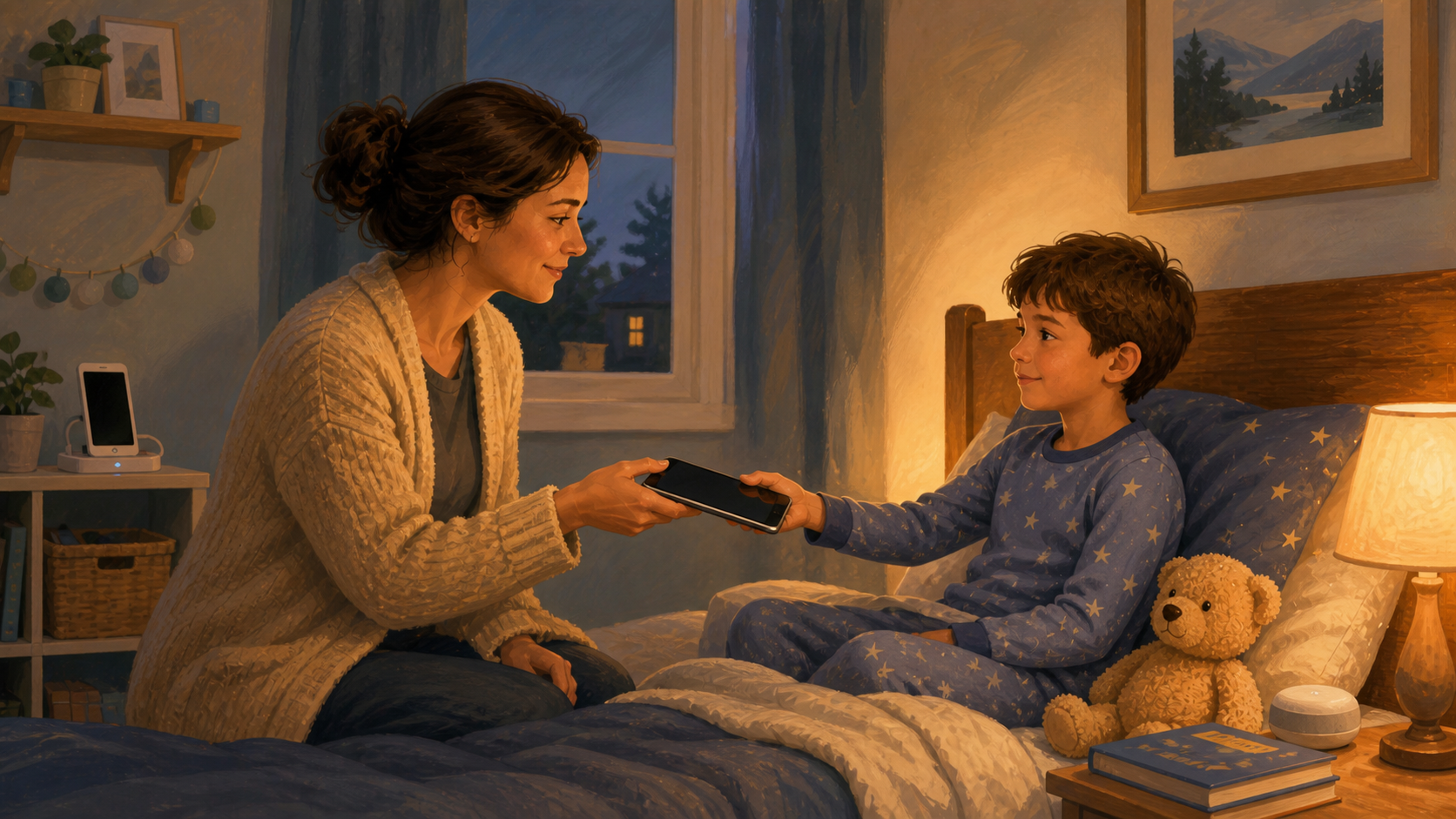
Parents hear two versions of the same advice all the time. One says screens ruin sleep. The other says the whole thing is overblown. The research-backed answer sits in the middle: screens really can interfere with sleep, but the strongest problems are not evenly spread across all screen use.
The biggest sleep risks are late-night access, screens in bed, and stimulating use close to lights-out. That means a family can make meaningful progress without treating every minute on every device as equally harmful.
Short answer: the clearest evidence supports protecting bedtime, keeping devices out of bedrooms, and being especially careful with interactive evening use like gaming, scrolling, and multitasking across devices.
Start with the sleep target, not the screen target
Before worrying about the perfect screen rule, it helps to anchor the goal. According to the CDC, drawing on the American Academy of Sleep Medicine consensus statement, children aged 6 to 12 need 9 to 12 hours of sleep per night, and teens aged 13 to 17 need 8 to 10 hours.
That matters because screen rules are not an end in themselves. They are a means of protecting the foundations that matter more: enough sleep, predictable mornings, better attention at school, and fewer end-of-day battles at home.
If you want the broader context for why raw daily minutes are not the whole story, start with The science behind screen time limits. Sleep is one of the clearest reasons family rules matter in the first place.
What the strongest research says
A 2016 JAMA Pediatrics systematic review and meta-analysis found a strong and consistent association between bedtime media-device use and worse sleep outcomes in children and adolescents. The odds of inadequate sleep quantity were higher, poor sleep quality was more common, and daytime sleepiness was more common too.
Just as important, the paper did not only point to active use. It also raised concern about simple access. If a phone or tablet is in the sleep environment, the barrier to checking it is already low.
That pattern shows up in other pediatric research too. A 2015 Pediatrics study found that children who slept near a small screen reported about 20.6 fewer minutes of weekday sleep than children who never did, and they were more likely to feel insufficiently rested.
The clearest sleep problem is not merely having screens during the day. It is having screens follow a child all the way into the bedroom and into bed.
The newer evidence is more nuanced, and that is useful
One reason parents get confused is that newer studies do not support the most simplistic version of the panic. A 2024 JAMA Pediatrics study used objective measures and found that total screen time in the two hours before bedtime was not associated with shorter total sleep time on its own.
But that is not the same as saying screens do not matter. The same study found that screen use after getting into bed was associated with shorter sleep, and that interactive use was especially problematic. Gaming and multitasking across devices stood out as particularly disruptive patterns.
That is a more useful message for families than a vague "screens are bad." It points to where the real leverage is. If your child watches something calm with the family after dinner and then puts the device away, that is different from gaming in bed, bouncing between apps, or scrolling until they feel too wired to sleep.
Why screens can interfere with sleep
The mechanisms are not mysterious. First, screens can simply displace sleep. If a child keeps using a device, bedtime moves later. Second, some content is activating. The American Academy of Pediatrics notes that screens can make children more alert and raise heart rate, especially with intense or action-heavy content.
Third, light is part of the story, even if it is not the only story. A controlled PNAS experiment in young adults found that evening use of a light-emitting e-reader delayed circadian timing and suppressed melatonin. That study was not done in children, so it should be used carefully, but it helps explain why pediatric bodies keep warning against late-night device use.
Useful framing: blue light matters, but it is not the whole problem. Timing, bedroom access, and how stimulating the activity is matter just as much.
What actually helps
The encouraging part of this literature is that the practical advice is not complicated. A 2021 systematic review and meta-analysis of interventions found that programs designed to reduce children's screen use also improved sleep duration and shifted bedtime earlier.
That lines up with official guidance. The CDC advises turning off electronic devices at least 30 minutes before bedtime. The AAP recommends avoiding screens for about an hour before bed and keeping phones and screens out of bedrooms at night. The Canadian Paediatric Society gives similar advice.
For most families, the best first rule is not "less screen time somewhere." It is "no screens in bed, and devices sleep outside bedrooms." That rule is easier to understand, easier to enforce, and much more closely tied to the research than a generic daily number.
How to apply this without creating a new nightly fight
If you try to remove a device from a tired child in the middle of a habit they already expect, you will usually get conflict. That does not mean the rule is wrong. It means the rollout matters.
- Set the rule before bedtime, not at bedtime: explain where devices charge and when they stop for the night.
- Prioritize interactive screens first: gaming, short-form video, and app-hopping are usually harder on sleep than passive family viewing earlier in the evening.
- Protect the same sequence every night: device away, shower, reading, lights out.
- Use structure instead of repeated arguments: if conflict is the main issue, pair bedtime boundaries with a wider routine your child already understands.
If your family mainly struggles with the arguing part, read Why screen time fights happen and Why parental controls alone don't work. Sleep rules hold better when they sit inside a broader system instead of depending on a tired parent improvising every night.
The bottom line
The evidence does support parent concern here. Bedtime screens are associated with poorer sleep, and bedroom access appears to matter a lot. But the most defensible version of the advice is more specific than "all screens are bad." The highest-risk pattern is late, interactive, in-bed use.
So if you want one practical, research-backed move to make this week, make it this: keep devices out of bedrooms overnight. Then build from there.
Sources and studies mentioned
- CDC: recommended sleep by age and bedtime guidance
- Carter et al. 2016, JAMA Pediatrics: systematic review and meta-analysis
- Falbe et al. 2015, Pediatrics: screens in the sleep environment
- Brosnan et al. 2024, JAMA Pediatrics: bedtime screen use and sleep
- Martin et al. 2021, Journal of Sleep Research: intervention meta-analysis
- Chang et al. 2014, PNAS: evening light-emitting e-reader experiment
- American Academy of Pediatrics: sleep and screen guidance
- Canadian Paediatric Society: sleep and screen guidance
Build a screen-time routine that protects sleep
Start with bedroom boundaries, then make the rest of the system predictable. If you want a practical next step, read the age-by-age screen time guide and join the waitlist for Android updates.