School holidays expose every weak spot in a family screen-time system. The school bell disappears, the weather gets colder, parents are still working, and suddenly the device that was supposed to fill one quiet half hour starts stretching across the whole day.
If that sounds familiar, the problem is not that you are failing at limits. It is that holidays remove structure. For Australian families heading into winter break, the goal is not to eliminate screens. It is to replace all-day negotiating with a plan your child can predict.
Short answer: do not aim for perfect. Aim for anchors. A holiday plan works best when screen time comes after a few fixed parts of the day, not whenever boredom appears.
Why school holidays make screen time feel harder
During term, school quietly does a lot of the work for you. Wake-up time is fixed. Mornings move quickly. There are fewer empty hours. Holidays remove that built-in structure, which means children suddenly have more unplanned time and parents have more decisions to make.
That matters because conflict usually grows in unstructured gaps. We see the same pattern in ordinary weeks too. In Why screen time fights happen, we argued that many battles are not really about one show or one game. They happen because a child wants certainty and a parent is forced to improvise boundaries repeatedly.
Winter break adds another pressure point: the day naturally shifts indoors. If it is cold, wet, or dark by late afternoon, screens become the default activity unless a family has already decided what comes first.
Use the calendar, but do not pretend Australia has one holiday date
This is one of those topics where location genuinely changes the advice, so it is worth being concrete. In Victoria, the government school winter holidays for 2026 run from Monday 29 June to Friday 10 July 2026. In NSW public schools, the winter holidays run from Monday 6 July to Friday 17 July 2026. Those dates come from official state school calendars, and other states and school systems can differ.
That means the best move is to plan the holiday routine before the last week of term, not once the break has already started. If your family waits until day three of the holidays to invent the rules, you are already negotiating from behind.
If you are reading this outside Victoria or NSW, use the same principle and just swap in your local dates. The plan matters more than the exact state.
Keep one research-backed boundary non-negotiable
Holiday flexibility is reasonable. Bedtime chaos is not. One of the clearest findings in pediatric screen-time research is that late-night access and screens in bed are much more strongly linked to poorer sleep than daytime use in general.
A 2024 JAMA Pediatrics study found that total screen use in the two hours before bedtime was not equally associated with less sleep, but screen use after getting into bed was associated with shorter sleep, and interactive use was especially disruptive. That makes holiday planning much simpler than many parents expect. You can allow some daytime looseness while still protecting the rule that matters most: devices do not follow children into bed.
If sleep is already a weak spot in your house, start with Screen time and sleep: the research every parent needs to know. Holidays go badly faster when kids are tired.
The holiday rule that works better than a daily argument
The most practical holiday system is not "you get two hours whenever you want." It is "screens happen after the daily anchors are done." That changes the feel of the day from bargaining to sequence.
- Anchor 1: morning start. Get up, get dressed, eat breakfast, and get out of pyjamas before any personal screen time.
- Anchor 2: movement. Put one active block before the first longer screen session, even if winter weather means it is a walk, scooter lap, backyard game, or indoor obstacle course.
- Anchor 3: one useful thing. This can be a chore, reading block, music practice, or school holiday worksheet. The point is that screens are not the first source of momentum in the day.
- Anchor 4: device cut-off. Decide in advance when the day starts winding down and keep bedrooms screen-free overnight.
This kind of plan is why simple restriction tools often disappoint parents. In Why parental controls alone don't work, we explained that blocking apps is not the same thing as creating a routine. Holiday peace usually depends more on sequence than software.
The goal is not to make every holiday hour productive. The goal is to stop screens from becoming the default answer to every empty moment.
What to do on working-from-home days
This is where many holiday plans break. Parents create a beautiful routine that assumes constant supervision, then real life arrives. A better plan is honest about which parts of the day you can actively run and which parts you need to contain.
On working days, think in blocks. You might have a morning outing or chore block, then a clearly defined screen block while you take calls, then lunch, then a second quieter activity. Children usually handle limits better when they know when the next screen slot is coming rather than hearing "not now" all day.
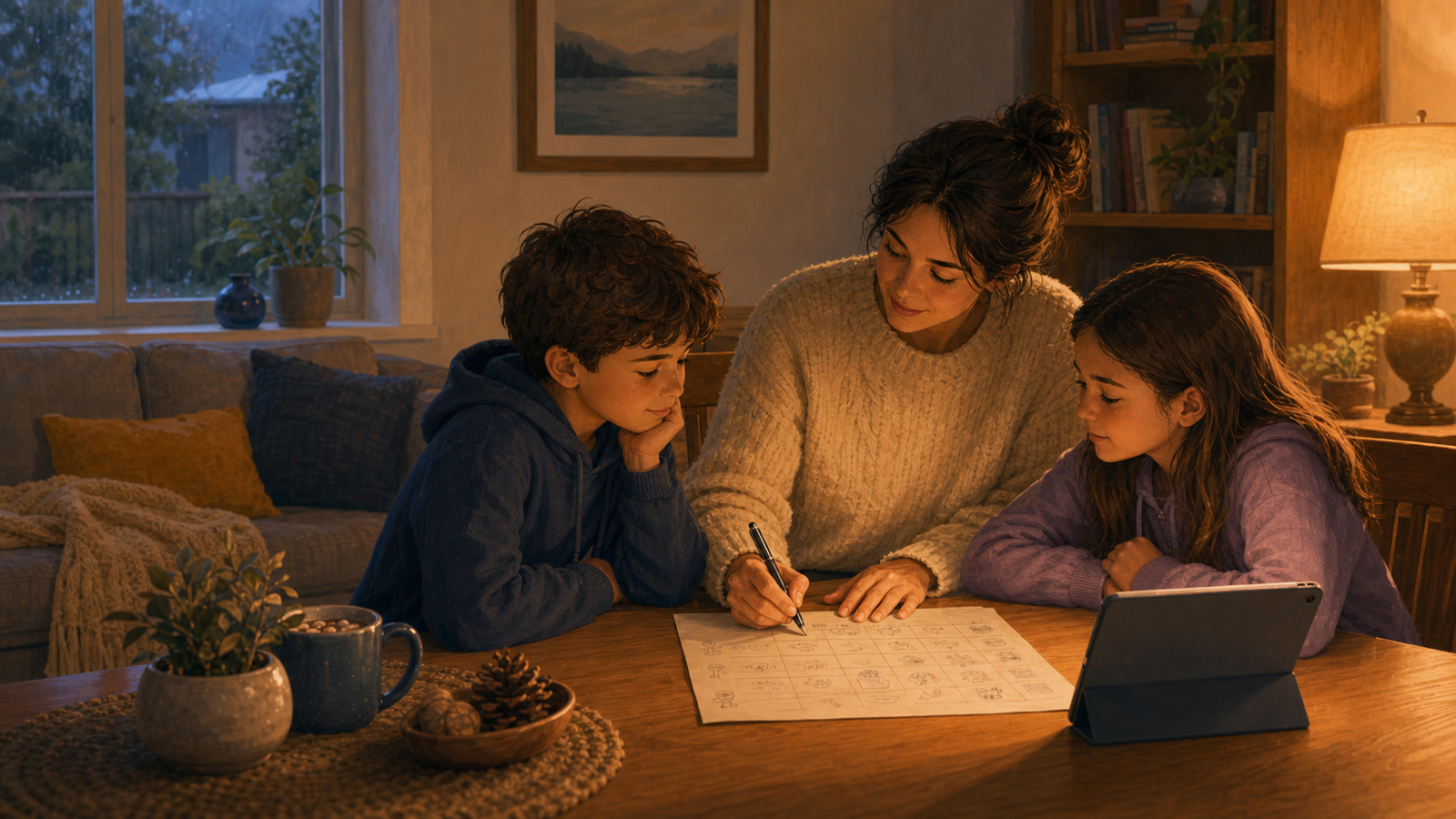
If your child is younger, visible structure helps. A whiteboard plan, paper checklist, or simple "first this, then that" note is often more effective than repeated verbal reminders. Older children usually need the same principle, just with more say in the order.
Make the holiday version of your rules slightly different, not completely different
Many parents swing between two extremes: strict term-time rules and no rules at all in the holidays. That sharp change is exactly what creates pushback when school returns.
A better approach is to keep the same values and adjust the volume. For example:
- More daytime flexibility, but the same bedtime cut-off.
- More family movie time, but not unlimited solo scrolling.
- More choice about when the screen block happens, but only after movement and one useful task.
If you need help calibrating what is age-appropriate, go back to the age-by-age screen time guide. A holiday plan should still match the child in front of you.
The bottom line
The winter school holidays do not need to become two weeks of nagging. But they do need a plan. In 2026, the break starts on 29 June for Victorian government schools and 6 July for NSW public schools, which means the best time to set expectations is now, before term ends.
Keep one or two daily anchors, protect sleep, and make screens part of the day rather than the shape of the day. That is what turns a holiday survival strategy into something calmer and repeatable.
Sources and references mentioned
- Victorian Government: 2026 school term dates and winter holiday dates
- NSW Department of Education: 2026 term dates and winter holiday dates
- Brosnan et al. 2024, JAMA Pediatrics: bedtime screen use and sleep
Set the holiday plan before the holidays start
Use this week to decide the anchors, then build from there. Read the age-by-age screen time guide, revisit why parental controls alone do not work, and join the waitlist for Android updates.