Parents usually reach for punishment when they are exhausted, not because it is their best idea. The tablet will not go away. The chore still is not done. Someone is yelling. So the rule becomes bigger, louder, and more urgent.
Reward systems can look like the opposite: calmer, clearer, and more practical. But they can also go wrong if every ordinary responsibility turns into a negotiation about what the child gets.
Short answer: developmental science generally points parents toward clear limits, positive reinforcement, and skill-building routines. Rewards can help when they make expectations visible. Punishment is weakest when it becomes the whole system.
The real question is what the child learns
A screen time rule is not just about today. It is also teaching a pattern: what happens before screens, how limits are handled, and whether responsibility comes before entertainment.
That is why "reward or punishment?" is too simple. A child can learn from both, but not always the lesson adults intend. A punishment-heavy system may teach, "Do not get caught." A thoughtful reward system can teach, "This is the order of our day: responsibilities first, screens after."
This is the same practical shift we covered in Why parental controls alone do not work. The enforcement matters, but the routine around the rule matters more.
What punishment does well and where it fails
Punishment can stop a behaviour in the moment. If a child throws a controller and the game ends, the link is clear. Some consequences are necessary because families need boundaries.
The problem starts when punishment becomes the main strategy. The American Academy of Pediatrics' policy statement on discipline argues for positive discipline approaches that teach and guide, while warning against harsh or punitive methods that can damage trust and increase behaviour problems.
That does not mean parents should be permissive. It means the limit should be firm, predictable, and connected to the behaviour. "The tablet is done because the timer ended" is different from "You are bad, so I am taking everything away."
The goal is not to make children afraid of the rule. The goal is to help them practise the rule until it becomes normal.
What rewards do well
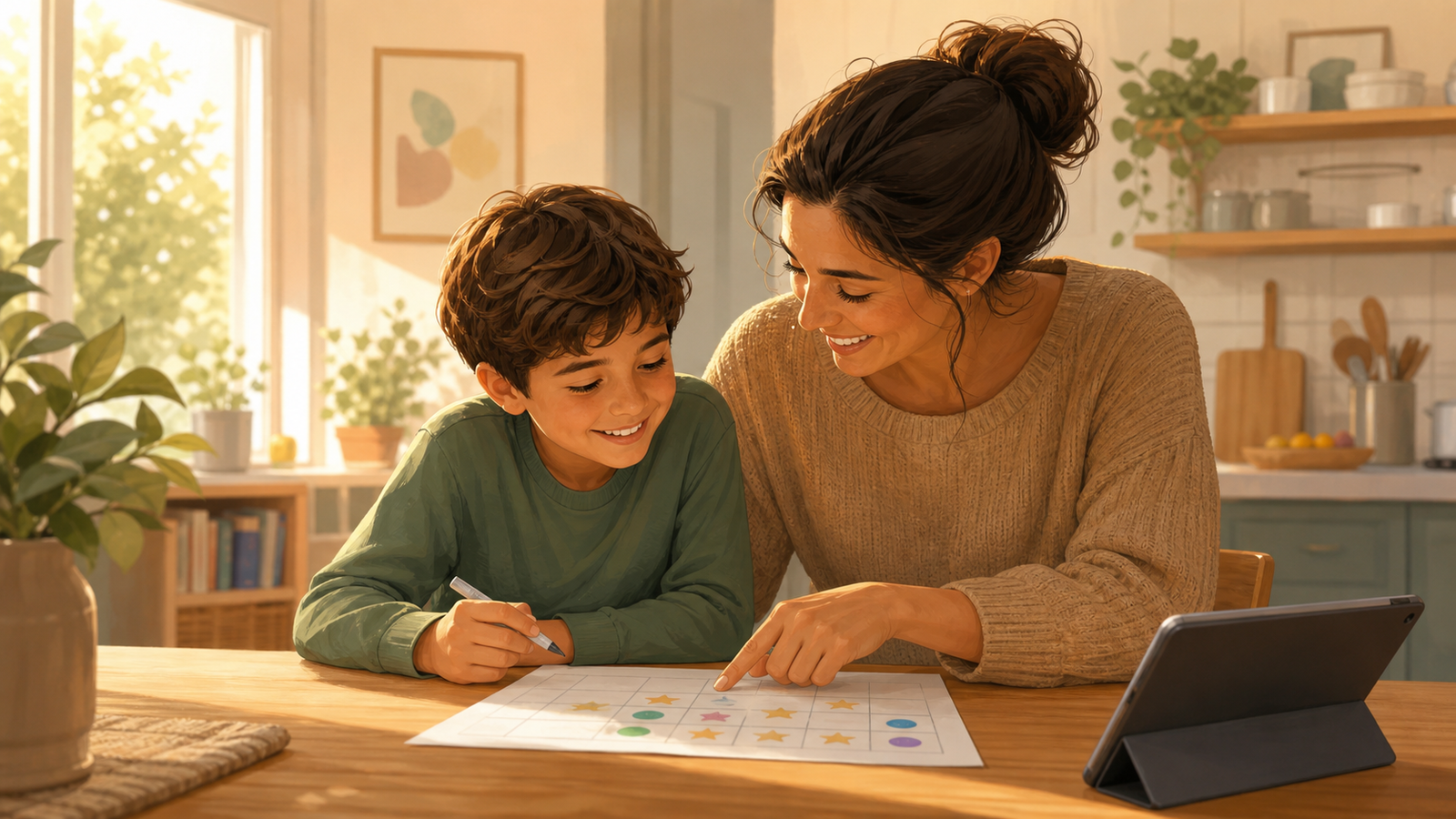
Rewards are useful because they make an invisible sequence visible. A child may understand "chores before screens" in theory, but a chart, token, timer, or app balance turns that rule into something concrete.
That matters for children because planning, impulse control, and task switching are still developing. If the reward system carries part of the memory load, the parent does not have to become the reminder every single day.
Rewards also work better when the task is specific. "Earn screen time by helping" is vague. "Put your plate in the dishwasher after dinner" is executable. We used the same principle in The chore chart that actually works: the child should be able to see the next action.
The risk: turning everything into a transaction
There is a real caution here. A classic meta-analysis by Deci, Koestner, and Ryan found that some expected tangible rewards can reduce intrinsic motivation, especially for tasks people already find interesting. That finding is often repeated as "rewards are bad," but the more useful interpretation is narrower.
Rewards are most risky when they replace meaning. If a child only ever hears, "Do this and you get that," chores can start to feel like a private contract instead of a family contribution.
For screen time, the better message is: "Screens come after responsibilities because that is how our family day works." The reward is part of the structure, not the whole reason to help.
Praise matters too
Parents often think the reward is the screen time, sticker, or point. But the adult response around the system matters just as much.
A review by Henderlong and Lepper found that praise can support motivation when it is sincere, specific, and focused on effort or strategy. Empty praise can feel controlling or meaningless. Specific praise helps a child notice what worked: "You started before I reminded you" or "You checked the chart and finished both steps."
That kind of praise is not a performance. It is feedback. It helps children connect their action with the outcome.
A better framework: firm limit, clear path, positive follow-through
If screen time has become a daily argument, try this structure:
- Firm limit: decide what earns screen time and what ends it.
- Clear path: make the next responsibility visible and small enough to start.
- Positive follow-through: notice completion, give the agreed access, and avoid renegotiating every day.
- Calm consequence: if the rule is ignored, keep the consequence related and predictable.
This is not about bribing children into good behaviour. It is about designing a system where the child has a way forward before the conflict begins.
So should screen time be a reward?
It can be, if the reward system is simple and values-led. Screen time is already motivating for many children. Pretending it is not will not help. The useful move is to put it in the right place in the day.
"No screens until your chores are done" often sounds like a threat. "Screens are available after your responsibilities are finished" says the same boundary with a different emotional shape. One invites a power struggle. The other describes a routine.
That difference matters most on hard days. When the system is visible, the parent does not have to invent a fresh argument. The child knows what comes next.
The bottom line
Developmental science does not say parents must choose between being strict and being warm. Children need both: limits that hold and systems that help them succeed inside those limits.
Use punishment sparingly, as a clear consequence when a boundary is crossed. Use rewards carefully, as a scaffold for responsibility rather than a price tag on every helpful act. And whenever possible, let the routine do more of the work than your voice.
Sources and references mentioned
- American Academy of Pediatrics 2018, Pediatrics: Effective Discipline to Raise Healthy Children
- Deci, Koestner, and Ryan 1999, Psychological Bulletin: rewards and intrinsic motivation meta-analysis
- Henderlong and Lepper 2002, Psychological Bulletin: effects of praise on children's intrinsic motivation
- Harvard Center on the Developing Child: InBrief, executive function
Build a routine kids can actually follow
Start with one responsibility before screens, keep the rule visible, and make the follow-through predictable. Read the research-backed chore chart guide, revisit why screen time fights happen, and join the waitlist for Android updates.