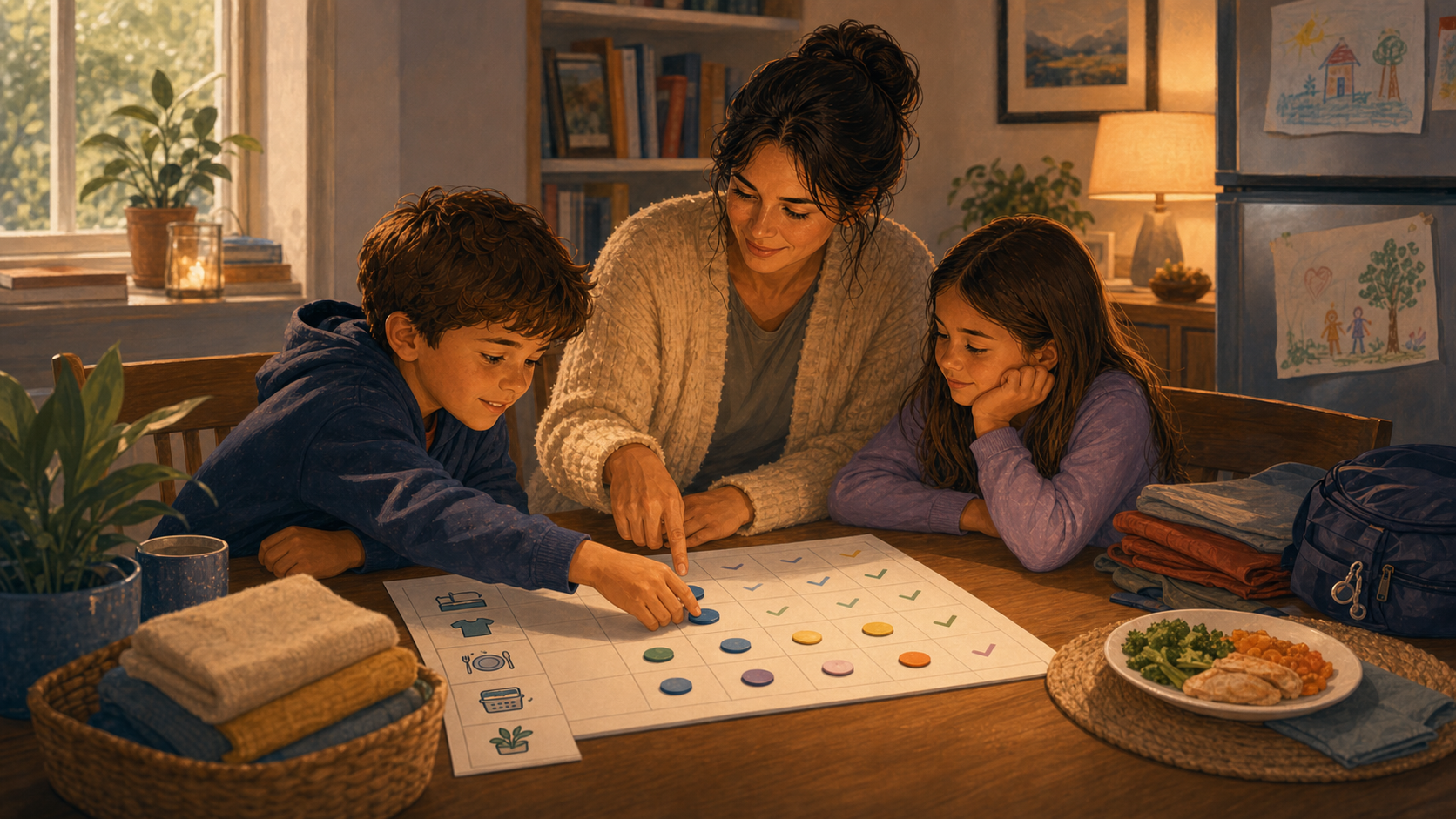
Most chore charts fail for boring reasons. The tasks are vague. The chart is hidden on a fridge nobody checks. The child has to remember a multi-step job alone. Or the whole system depends on a parent having enough energy to nag at the exact right moment.
A chore chart that works is not magic. It is a small piece of family infrastructure. It makes the expectation visible, keeps the task age-appropriate, and turns "go help" into something a child can actually start and finish.
Short answer: the best chore charts are specific, visible, predictable, and framed as contribution. They reduce negotiation because the chart carries part of the reminder burden.
Start with the real job of a chore chart
The point of a chore chart is not to decorate a wall. It is to lower the amount of parent management required to get ordinary household tasks done.
That matters because children are still developing the executive function skills adults often take for granted: remembering a task, sequencing steps, resisting a distraction, checking whether the job is finished, and moving on. Harvard's Center on the Developing Child describes executive function as the mental skills that help people hold information in mind, control impulses, and manage tasks toward a goal.
That is the useful lens for chores. A child who "knows" they should clean the table may still struggle to turn that instruction into action. A visible chart with a clear next step removes some of the memory and planning load.
If your family is mostly stuck in arguments about screens, this is the same principle we covered in Why screen time fights happen: structure beats repeated improvisation.
Make the task smaller than you think
Many charts fail because the adult writes the outcome, not the action. "Clean your room" sounds simple to an adult. To a child, it may mean clothes, toys, rubbish, books, school gear, and bedding all at once.
A better chart names the next visible action:
- Put dirty clothes in the basket.
- Put dinner plate in the dishwasher.
- Feed the dog before breakfast.
- Put school shoes by the door.
- Wipe the table after dinner.
This is not lowering standards. It is making the standard executable. For younger children especially, a task should be something they can see, do, and mark complete without needing a lecture every time.
Frame chores as contribution, not just compliance
One of the strongest reasons to be careful with chore charts is that they can accidentally turn every helpful act into a transaction. Research on early helping is useful here. In a well-known Science study, very young children showed spontaneous helping behaviour. A later Developmental Psychology study found that expected material rewards could reduce toddlers' later helping.
Those studies are not a direct test of chore charts for school-age children, so they should not be stretched too far. But they do support a practical warning: if every household task becomes "What do I get?", children can lose the sense that helping is part of belonging to a family.
A chore chart works best when it says, "This is how our family runs," not only, "Do this or else."
ScreenRewards is built around earned screen time, so this distinction matters. Rewards can be useful when they make routines concrete. They become weaker when they replace the deeper message that everyone contributes.
Connect chores to the routine that already exists
The best place for a chore is next to something that already happens. After breakfast. Before screens. After dinner. Before bedtime. A chore with no anchor has to be remembered from scratch, which makes it much easier to ignore.
This is also where screen time can help as a sequence rather than a bribe. "Screens after the table is cleared" is cleaner than "Please, please clear the table so I can stop asking." The order does the work.
That sequence also fits what we argued in The psychology of why kids push back on screen time limits. Children resist harder when rules appear suddenly. A visible routine makes the expectation exist before the conflict.
Use rewards carefully
Rewards are not automatically bad. The evidence on motivation is more nuanced than that. A classic Psychological Bulletin meta-analysis found that certain expected, tangible rewards can undermine intrinsic motivation, especially for interesting tasks. But chores are not always "interesting tasks." Taking bins out or wiping a bench is often simply part of household life.
The practical takeaway is not "never reward chores." It is to avoid making every helpful behaviour feel like a private business deal. Use rewards to make a routine visible and consistent, while still naming the family value underneath: we all help because we all live here.
The chore chart that works
If you are starting fresh, keep it boring and clear:
- Pick three chores, not fifteen. A small chart that gets used beats a beautiful chart that collapses by Wednesday.
- Use concrete actions. "Put plate in dishwasher" is better than "help after dinner."
- Anchor each chore to a routine. Before school, after dinner, before screens, or before bedtime.
- Make completion visible. Tick, magnet, sticker, or app check-off. The child should see progress.
- Review weekly. If a chore never happens, shrink it, move it, or swap it. Do not just nag harder.
For a child who is new to chores, the first win is not perfect independence. The first win is reducing the daily argument and building a routine the child can repeat.
The bottom line
The research does not support the idea that a chore chart is magic. It supports something more practical: children benefit from clear routines, visible cues, and chances to contribute in ways they can actually manage.
So the chore chart that works is not the fanciest one. It is the one your child can understand on a tired Tuesday afternoon, without you having to rebuild the whole system from memory.
Sources and references mentioned
- Harvard Center on the Developing Child: activities guide for executive function skills
- Warneken and Tomasello 2006, Science: altruistic helping in young children
- Warneken and Tomasello 2008, Developmental Psychology: rewards and spontaneous helping
- Deci, Koestner, and Ryan 1999, Psychological Bulletin: rewards and intrinsic motivation meta-analysis
Turn chores into a routine, not a negotiation
Start with three clear tasks, anchor them to the day, and make completion visible. Read why kids push back on screen limits, revisit why parental controls alone do not work, and join the waitlist for Android updates.