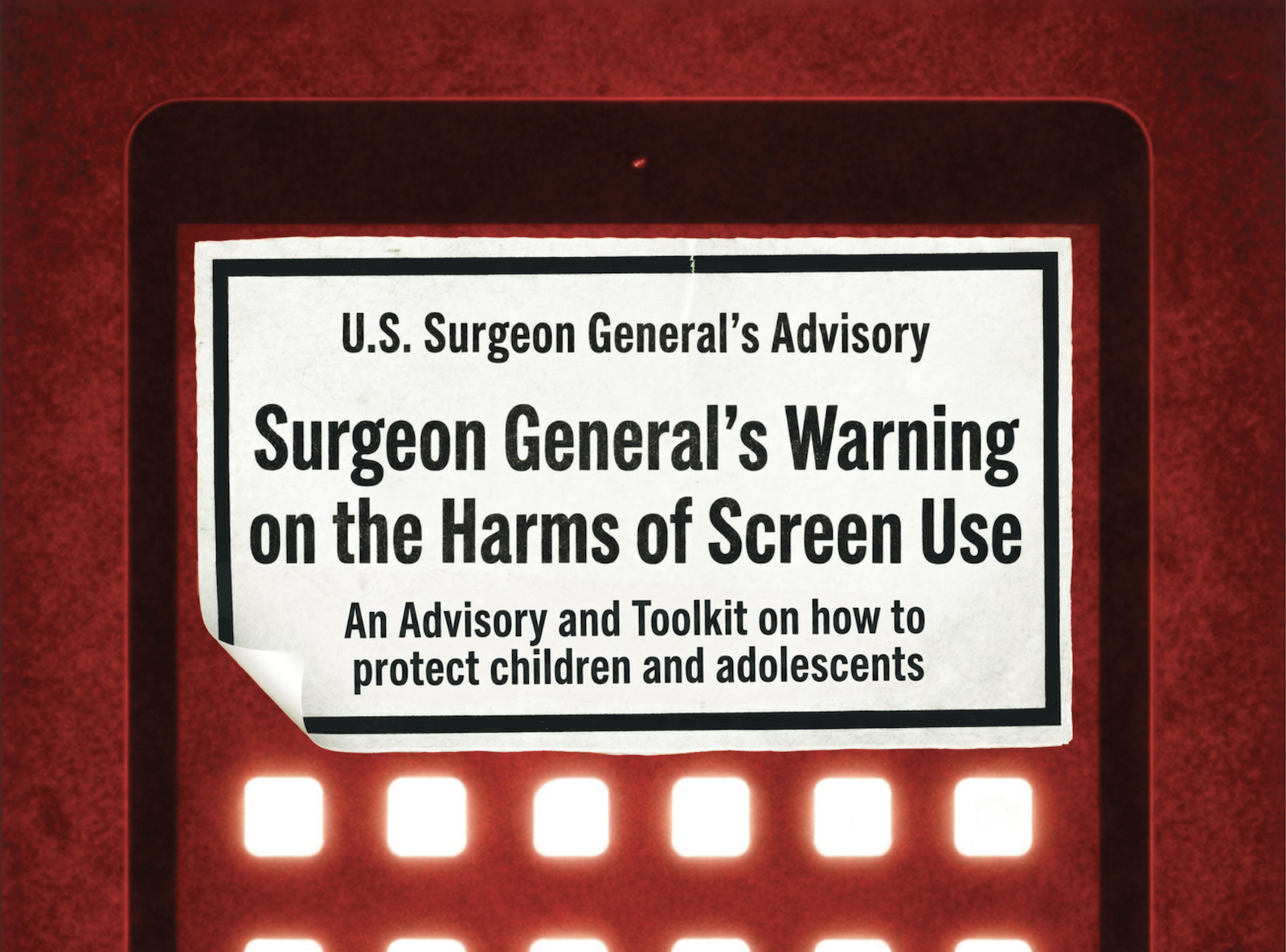
On May 20, 2026, the US Department of Health and Human Services released a 43-page Surgeon General's advisory warning that excessive screen use among children and teenagers constitutes a public health concern. It is the most significant federal statement on children and screens to date — and it lands at a moment when most families already know something needs to change.
This post breaks down what the advisory actually says, what the research behind it shows, and what it means for your family in practice.
What the advisory actually says
The advisory sets out specific age-based guidelines that are clearer than anything the federal government has previously published on this topic:
- Under 18 months: no screen time at all, with the exception of video calls.
- Under 6 years: a maximum of one hour per day.
- Ages 6 to 18: a maximum of two hours per day.
The advisory is specifically targeting recreational and passive screen use. Time spent on schoolwork or educational content sits in a different category — the two-hour limit is about leisure use, not all device time equally.
The numbers are stark when set against reality. By the time children become teenagers, they average more than four hours of screen use per day. Nearly half of adolescents say they lose track of how long they have been on their phones. Many spend more time on screens than they spend sleeping or at school.
"This advisory is not only a warning, but also an invitation for all of us to enjoy a broader world, beyond the confines of screens." — HHS Secretary Robert F. Kennedy Jr.
Why this advisory is different from past guidance
Parents who have been following this space will know that the American Academy of Pediatrics has gradually moved away from hard limits, shifting toward "family media plans" and context-based guidance over the past several years. The Surgeon General's advisory goes in the opposite direction — putting specific numbers back on the table.
It also does something that parent-level guidance cannot: it calls on schools, tech companies, healthcare providers, and policymakers to act alongside families. Specifically, it recommends bell-to-bell phone restrictions during school hours, requires tech companies to design for user wellbeing rather than engagement, and asks healthcare providers to screen for screen use at annual appointments — the same way they screen for nutrition and sleep.
That broader framing is important. It signals that the federal government no longer sees this as a parenting problem alone.
What the research behind it shows
The advisory draws on a growing body of evidence linking heavy screen use to outcomes across sleep, learning, physical health, and mental wellbeing. The patterns that appear most consistently across studies are:
- Sleep disruption: Screen use — particularly in the hour before bed — is associated with delayed sleep onset, shorter sleep duration, and poorer sleep quality. A 2025 study in PLOS Global Public Health found that it was the sleep disruption itself, not screen exposure directly, that drove harm in adolescents.
- Academic performance: Screen use during study time and in the hour before sleep is consistently associated with lower academic outcomes across age groups.
- Physical activity: Time on devices tends to displace movement, particularly for children who use screens as a default way to fill unstructured time.
- Mental health: This is where the research is most concerning for older children. The advisory cites evidence that higher and particularly harmful screen use is associated with increased risk of self-harm and suicidal behaviours, especially among adolescents. It also notes that getting a first smartphone between ages 12 and 13 was associated with clinically significant mental health problems by age 13.
Important nuance: researchers are careful to note that much of this evidence shows correlation, not proven causation. Not all screen time is equally harmful — educational use, video calls with family, and supervised co-viewing are different from passive scrolling or late-night social media. The advisory acknowledges this, noting that "evidence around the impacts of screen use is evolving," but argues the nation "cannot wait for every question to be settled before acting."
What this means practically for your family
The two-hour guideline for children aged 6 to 18 is a ceiling, not a target. If your child currently uses screens for 45 minutes after school and reads before bed, you are not behind. If your teenager is at four hours a day outside of schoolwork, the gap is real and worth addressing — but the answer is rarely a hard overnight cut.
A few of the advisory's specific recommendations are worth highlighting because they are unusually concrete:
- Remove devices from bedrooms overnight. This single change has among the strongest research support of anything in the advisory. The hour before sleep is when screen use does the most damage, and having a device out of the bedroom removes the temptation entirely.
- Build a family media plan. The advisory recommends that families define in advance when and how screens can be used at home — not a reactive "hand it over" approach, but a pre-agreed structure that children understand.
- Model the behaviour. Children notice when the rules apply differently to adults. If screens are at the dinner table for parents, it is harder to enforce the rule for children.
If you want a starting point for the limits themselves, our age-by-age screen time guide builds out what these numbers look like in practice at five, eight, ten, and thirteen-plus — and anchors them in daily routines rather than willpower.
The deeper point the advisory is making
The advisory is not simply telling parents to take away devices. It is making a structural argument: the current digital environment is designed to maximise engagement at the expense of child wellbeing, and families cannot be expected to fight that design alone without help from schools, companies, and policymakers.
That framing will resonate with any parent who has discovered that "just tell them to stop" does not work — not because children are defiant, but because the apps and platforms they are using are specifically engineered to be hard to stop. We go deeper on this in Why screen time fights happen.
The advisory's most useful practical implication is this: limits work best when they are predictable, visible, and enforced by something other than a tired parent repeating themselves at the end of a long day. The families who manage screen time well are not more patient or more consistent — they have built a structure that does not depend on constant intervention. The science behind why that matters is in The science behind screen time limits.
The bottom line
The Surgeon General's advisory is a meaningful escalation in how seriously the US government is treating children's screen use. The specific limits it sets — two hours a day of recreational screen time for school-age children — are the clearest federal benchmarks to date, and the evidence connecting heavy use to sleep loss, academic decline, and mental health risk is substantial even where causation is still being studied.
For most families, the advisory is not a reason to panic. It is a prompt to take an honest look at the structure you have in place — and whether it is holding up under the daily pressure of kids who would prefer more time and platforms that want to give it to them.
"Prioritize completion of desirable activities first, such as chores, homework, music, or sports before screen use." — US Surgeon General's Advisory, May 2026
ScreenRewards is live on the App Store — today.
We built ScreenRewards to be exactly the kind of system the advisory is describing: clear rules, consistent enforcement, and kids who earn their screen time rather than fight for it. Available now on iOS, coming soon to Android.